


| Issue |
Int. J. Simul. Multidisci. Des. Optim.
Volume 17, 2026
Recent Advances in Hyperparameter Tuning for Machine Learning Models
|
|
|---|---|---|
| Article Number | 7 | |
| Number of page(s) | 10 | |
| DOI | https://doi.org/10.1051/smdo/2026003 | |
| Published online | 20 March 2026 | |
Research article
Maintenance optimization for rolling bearing based on delay time model
The University of Danang - University of Science and Technology, 54 Nguyen Luong Bang Street, Danang, Viet Nam
* e-mail: This email address is being protected from spambots. You need JavaScript enabled to view it.
Received:
8
October
2025
Accepted:
24
December
2025
Abstract
Rolling bearings are critical components in rotating machinery, directly influencing system reliability and performance. Bearing failures, driven by stochastic degradation processes, necessitate accurate reliability assessment and maintenance optimization to minimize costs and downtime. This study proposes an adaptive inspection and maintenance model for rolling bearings based on the Delay Time Model (DTM), which captures the two-stage failure process: a normal operating stage until a hidden defect emerges, followed by a delay time until failure. The DTM leverages the failure delay time to schedule preventive maintenance, preventing costly failures. By modeling the defect initiation and delay time distributions using Weibull distributions, a maintenance cost model is developed to determine optimal periodic inspection intervals that minimize the long-term expected cost per unit time. A parameter estimation framework is established for both continuous and discrete inspection data, ensuring robust model applicability. The proposed approach is validated using a real-world run-to-failure dataset, demonstrating its effectiveness in optimizing maintenance schedules. Key contributions include the application of DTM to rolling bearing lifetime modeling, the formulation of a cost-effective inspection and maintenance strategy, and empirical validation through a case study. This work provides a practical framework for enhancing rolling bearing reliability and reducing maintenance costs.
Key words: Rolling bearing / delay time model / maintenance optimization / condition-based maintenance
© M.-H. Bui et al., Published by EDP Sciences, 2026
 This is an Open Access article distributed under the terms of the Creative Commons Attribution License (https://creativecommons.org/licenses/by/4.0), which permits unrestricted use, distribution, and reproduction in any medium, provided the original work is properly cited.
1 Introduction
Rolling bearing, one of the most important components of rotating machinery, whose running state directly influences the health of the whole equipment [1]. Bearing failures, a leading cause of mechanical breakdowns, result from stochastic degradation processes influenced by variable operating conditions, random fatigue damage, and diverse failure modes such as spalling and pitting [2,3]. These complexities make accurate Remaining Useful Life (RUL) prediction challenging yet essential for optimizing maintenance and minimizing costs [4]. Condition-based maintenance (CBM) has emerged as a key strategy, leveraging real-time health monitoring to schedule maintenance based on the bearing’s actual condition [5]. The failure of rolling bearings typically follows a two-stage process: a normal operating stage until a hidden defect is identified, followed by a failure delay time until failure occurs, as illustrated by vibration data (Fig. 1). The DTM effectively captures this two-stage degradation by modeling the time from defect initiation to failure, providing opportunities for preventive maintenance to mitigate costly failures [6].
Despite extensive research on RUL prediction, there is a notable gap in inspection and maintenance optimization for rolling bearings, particularly for systems without continuous monitoring capabilities [7]. While continuous inspections provide real-time degradation data, they require costly integrated monitoring devices, which are often impractical for existing industrial equipment [8]. Discrete inspections, either periodic or non-periodic, are more feasible but present trade-offs. Non-periodic inspections, driven by system state, can reduce inspection frequency but introduce complexities such as missed defects and logistical disruptions [9]. While highly flexible adaptive or non-periodic inspection policies exist in literature, they often require costly integrated monitoring devices and can introduce logistical complexities. In contrast, periodic inspections offer simplicity and cost-effectiveness, making them the most feasible approach for existing industrial equipment with limited measurement capabilities [10]. This study, therefore, focuses on optimizing the practical and widely implementable periodic inspection interval within the DTM framework for rolling bearings to optimize maintenance costs and downtime. The model incorporates a reliability and cost framework to determine optimal inspection intervals and includes parameter estimation for practical implementation. Validated using a real-world bearing failure dataset, this work contributes to enhanced reliability and cost efficiency in industrial maintenance.
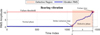 |
Fig. 1 Vibration data of rolling bearing (Nectoux et al., 2012). |
2 Literature review
Accurate RUL prediction is critical for optimizing maintenance of rolling bearings, which exhibit complex degradation patterns due to variable operating conditions and random failure modes [11]. Therefore, extensive studies have been conducted for bearing’s RUL prediction. Stochastic models, such as Wiener and Gamma processes, are widely used for RUL prediction. For example, [12]. employed a Wiener process with improved Kalman filter, using vibration data to estimate bearing’s RUL. Kuzio et al. (2025) applied a Gamma process to predict bearing RUL considering time-varying characteristics [13]. These models, however, often assume homogeneous degradation process, which may not fully capture the distinct two-stage degradation process of bearings: a normal operating phase followed by a defect propagation phase leading to failure.
Data-driven approaches have gained prominence for handling non-linear degradation patterns. [14] developed a Long Short-Term Memory (LSTM) network to predict RUL from raw vibration signals, outperforming traditional statistical methods in noisy environments. (Guo et al., 2024) proposed a hybrid model combining a Wiener process with Dual-Channel Transformer Network and the Convolutional Block Attention Module, enhancing RUL estimation for bearings [15]. (Pang et al., 2021) introduced a Bayesian framework for real-time updating of degradation parameters, enabling adaptive RUL predictions based on continuous monitoring [16]. While effective, these approaches often rely on continuous data and may not explicitly model the defect initiation and propagation stages inherent in bearing degradation.
The DTM addresses the limitations of homogeneous degradation models by explicitly capturing the two-stage degradation process: defect initiation followed by a delay time to failure [17]. The failure delay time provides a critical window for preventive maintenance (PM) [18]. In that way, with the help of monitored state information, defective state can be identified, and PM can be performed before failure occurs. Therefore, several models have been developed based on DTM to optimize maintenance plan. For example, Santos et al. (2023) apply DTM to optimize the maintenance plan for cone crusher equipment [19]. A. Santos et al. (2021) discussed the application of DTM for maintenance of reused items [20]. W. Wang (2006) applied DTM for condition-based maintenance of water pump [21]. More studies in application of DTM for maintenance optimization can be found in [18].
Despite its versatility, the application of DTM to rolling bearing maintenance using vibration data remains underexplored, particularly for systems with discrete inspections. As shown in Figure 1, bearing degradation aligns with DTM’s framework, with vibration signals indicating defect initiation and propagation. Existing models often overlook the practical constraints of discrete inspections and cost-effective maintenance strategies. This study addresses these gaps by:
Applying DTM to model the two-stage lifetime of rolling bearings.
Developing a periodic inspection and maintenance model to minimize costs and downtime.
Formulating a parameter estimation framework for both continuous and discrete inspection data.
Validating the model using a real-world bearing failure dataset.
These contributions provide a robust framework for optimizing maintenance schedules, enhancing bearing reliability, and reducing costs in industrial applications.
To describe these contributions, the remainder of this paper is organized as follows. Section 3 introduces inspection and maintenance model. In this section, the maintenance cost model is also developed, which served as objective function for maintenance optimization. Section 4 describe a case study on maintenance optimization for rolling bearing based on a real failure dataset. Finally, Section 5 summarizes the key findings and discusses potential direction for future developments.
3 Inspection and maintenance model
Prior to formulating the maintenance and inspection model, the following assumptions, grounded in industrial practices and existing literature, are established:
The bearing failure process adheres to the DTM, as depicted in Figure 2.
Accordingly, a random defect emerges at time U (here called as defect initiation time), characterized by a probability density function g(u). Failure occurs after a delay time h, described by a probability density function f(h) and cumulative distribution function F(h), independent of U.
The system undergoes renewal either through a failure repair or a preventive maintenance (PM) during an inspection if a defect is detected.
Following either a failure renewal or a PM renewal, the inspection process restarts.
Failures are repaired immediately, incurring an average cost of cf.
A defective system identified during an inspection is renewed at a cost cp.
Inspections are assumed to be perfect, accurately revealing the system’s true state. Due to environmental variations, disturbances, and technological limitations, measurement devices are prone to errors. However, inspection can be considered as perfect when inspection errors are negligible.
Based on these assumptions, the inspection and maintenance model is developed in the subsequent section.
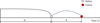 |
Fig. 2 Delay time concept. |
3.1 Description of inspection and maintenance model
To reduce the risk of failure, bearing is inspected periodically with inspection interval τ. The inspection incurs a cost of ci. Based on the inspection result, the maintenance decision is made as follows:
If bearing is in normal state at inspection Tk = kτ, no action is taken, and bearing continues operation until the next inspection.
If a defective state is detected at Tk = kτ, Preventive maintenance (PM) is performed to restore the system to as good as new state with a cost of cp.
If bearing is in failure state at inspection Tk = kτ, Corrective maintenance (CM) is applied with a cost of cf. Failure of the bearing could lead to huge economic loss; therefore, it is assumed that cf > cp.
The inspection and maintenance models are illustrated in Figure 3. As depicted in Figure 3a, at inspection epochs T1, T2 and T3, bearing is in running state; therefore, no action is taken at these inspection epochs. At inspection epoch T4, system is found in defective state, and PM is applied to restore the bearing to as good as new state. Additionally, as depicted in Figure 3b, the system is found to be in failure state in inspection epoch T3, CM is applied at T3 to restore system to as good as new state.
As showed in Figure 3, inspection interval plays an important role, which significantly contributes to the effectiveness of the maintenance models. A short interval increases inspection frequency and costs, while a long interval raises the risk of undetected failures, increasing overall maintenance costs. Therefore, inspection interval should be optimized to achieve that optimal maintenance cost.
In the next subsections, maintenance cost model is developed, which served as objective function for maintenance optimization.
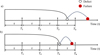 |
Fig. 3 Illustration of inspection and maintenance model with (a) Preventive maintenance case and (b) Corrective maintenance case. |
3.2 Maintenance cost model and optimization
Since system state is restored to as-good-as new state either PM or CM is applied. Therefore, the process is renewal process. The long-term expected cost per unit time, C∞ (τ) is given by (Ross et al., 1996) [22]:
 (1)
(1)
Where,  and
and  are the expected renewal cycle cost and cycle length, respectively. There could be two different renewal cycles, one is the failure renewal and another is PM renewal cycle.
In the case of renewal cycle by failure, it is assumed that system is found to be in failure state at inspection epoch Tk = kτ:
 (2)
(2)
Equation (1) represents one possible scenario where failure occurs within a specific inspection interval. Since failures may occur in any interval, the expected cost due to failure is obtained by summing over all possible intervals k from 1 to infinity,
 (3)
(3)
Although equation (3) involves a summation over infinite intervals k, it remains finite in practice, as the probability terms diminish to zero for large k. This occurs because the probability density function g(u) approaches zero for u > (k – 1)T, when k is sufficiently large.
Similarly, the expected cost due to PM renewal is:
 (4)
(4)
In that way, the expected renewal cost is obtained by:
 (5)
(5)
In the similar manner, the expected cycle length is also obtained as:
 (6)
(6)
Finally, the expected maintenance cost per unit time is:
See Equation (7) below
 (7)
(7)
The optimal inspection interval is obtained as the minimum value of expected maintenance cost per unit time.
3.3 Parameters estimation
The maintenance model requires the estimation of distribution of initial defect time (U) and delay time (h). Failure of the bearings usually follows Weibull distribution [23]. Therefore, it is assumed that initial defect time (U) and failure delay time (h) follows a Weibull distribution. The Weibull distribution for a random variable T (representing either U or h) has the probability density function (pdf) [24]:
 (8)
(8)
And cumulative distribution function:
 (9)
(9)
Where, β > 0 and θ > 0 are the shape and scale parameters.
For defect initial time U, the distribution F(U) has parameters βu and θu. For delay time h, the distribution g(h) has parameters βh and θh.
The estimation of the distribution parameters for defect initial time and delay time is based on the nature of failure data. Two kinds of data can be considered: continuous inspection data and discrete inspection data.
3.3.1 Continuous inspection data
Continuous inspection data provide exactly defect initial time and delay time. It is supposed that a set of N failure data, including defect initial time and delay time  . Based on these failure data, the distribution parameters for Defect initial time and delay time can be estimated. Maximum Likelihood Estimation is a robust method for estimating Weibull parameters.
The likelihood function for defect initiation time is:
 (10)
(10)
The log-likelihood function:
 (11)
(11)
Equation (11) can be simplified as:
 (12)
(12)
To estimate (βu, θu) maximize the log-likelihood functions by taking partial derivatives of log L(βu, θu) with respective to βu and θu, set them to zero, and solve:
 (13)
(13)
 (14)
(14)
From equation (16), one has:
 (15)
(15)
Substitute equation (15) into equation (13) and solve numerically to obtain βu.
Since the distributions of Ui and hi are independent, the parameters can be estimated separately. Therefore, similar approach can be applied to estimate βh, θh.
3.3.2 Discrete inspection data
With discrete inspection, at each inspection epoch Tk, the observation system state is:
Defect state: A defect has initiated (i.e., Ui < Tk), but failure has not occurred (i.e., Ui + hi > Tk).
Failure state: System has failed (i.e., Ui + hi < Tk).
Normal state: No defect has initiated (i.e., Ui > Tk).
It is assumed that m inspections at fixed time T1, T2,.., Tm with observation across N bearings. Each bearing i is inspected periodically, and at each inspection time Tk, one of three states is observed:
-
Normal state: No defect has initiated (i.e., Ui > Tk) with probability:
 (16)
(16) -
Defect state: A defect has initiated (i.e., Ui < Tk), but failure has not occurred (i.e., Ui + hi > Tk), with probability:
 (17)
(17)where,
 (18)
(18) (19)
(19) -
Failure state: System has failed (i.e., Ui + hi < Tk) with probability:
 (20)
(20)
For each bearing i, the inspection history provides a sequence of states until a defect or failure is observed. Therefore, the likelihood function is constructed based on the observed states across all system and inspections.
Let:
Nn denotes the number of normal state observation at Tk.
Nd denotes the number of defect state observation at Tk.
Nf denotes the number of failure state observation at Tk.
For each bearing i, the contribution to likelihood depends on its inspection history:
Normal state at Tk: Contributes
 .
.Defect state at Tk: Contributes
 , and typically, the bearing is renewed and restarting the process.
Failure state at Tk: Contributes
 , followed by renewal.
Assuming that each bearing is observed until defect or failure, and renewed thereafter, the likelihood for bearings system is:
 (21)
(21)
Where, Li is the likelihood for bearing i, based on its inspection history. For example, if bearing i is normal at T1, T2,.., Tk-1 and defective at Tk, then:
 (22)
(22)
If bearing i is normal at T1, T2,.., Tk-1 and failed at Tk, then:
 (23)
(23)
The total likelihood aggregates contributions from all systems, accounting for all observed states. The log-likelihood is:
 (24)
(24)
Maximize log L with respect to βu, θu βh,θh using numerical methods to estimate the value of βu, θu βh,θh.
4 Case study on maintenance of bearing based on failure data
4.1 Maintenance optimization
To demonstrate the practical applicability of the proposed inspection and maintenance model based on the DTM, a case study is conducted using the publicly available run-to-failure dataset from the FEMTO-ST Institute, generated via the FRONOSTIA experimental platform [25]. This platform is designed to perform accelerated life tests by subjecting rolling element bearings to radial loads exceeding their dynamic ratings, thereby inducing natural degradation within a managed timeframe.
The dataset comprises monitoring data from 17 bearings (divided into 3 datasets) tested under three distinct operating conditions characterized by varying speeds and loads: 1800 rpm with 4000 N, 1650 rpm with 4200 N, and 1500 rpm with 5000 N. The datasets captures bearing degradation from normal operation to failure, making it suitable for validating the two-stage degradation process modeled by DTM. This study analyses second test set of the FEMTO-ST dataset. The vibration data of the rolling bearing in this test set is shown in Figure 4.
From the vibration data, the defective initiation time, delay time and failure time of the bearings are provided in Table 1. It should be mentioned that the initiation defect time is determined based on the 3σcp criterion and engineering judgement method, where σcp is the standard deviation of the system degradation level during normal phase [15].
Based on failure data, the bearing’s degradation parameters are estimated according to Section 3.3. The estimated data is provided in Table 2. In addition, it is assumed that the maintenance cost of the bearing is provided in Table 2.
Then, the distribution of defect initiation time, failure delay time are estimated using method described in Section 3.3.
By minimizing long term maintenance cost rate in equation (7), the optimal inspection interval can be determined. Figure 5 present the expected maintenance cost per unit time as a function of inspection interval.
As showed in Figure 5, the optimal maintenance cost rate is 0.156 (cost unit), obtained at inspection interval τ = 75 (time unit).
Defective initiation time, delay time and failure time of the bearings.
Degradation and maintenance parameters of the rolling bearing.
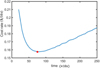 |
Fig. 5 Expected maintenance cost per unit time as a function of inspection interval. |
4.2 Comparison study
To evaluate the effectiveness of the proposed DTM-based maintenance model, a comparative analysis is conducted against a conventional time-based preventive maintenance (TBM) model. In the TBM model, preventive maintenance is scheduled at fixed intervals (tp), with the optimal interval determined by minimizing the long-term expected cost rate:
 (25)
(25)
Where, R(t) is the reliability of the system at time t; cp and cf are preventive and corrective maintenance costs, respectively (cf > cp). It is also assumed that failure of the bearing followed Weibull distribution, ie.,
 (26)
(26)
Where, βf and θf are shape and scale parameters of Weibull distribution, represent the failure time of the bearing.
The optimal prevetinve maintenance interval (t*p) is found by minimizing: the long-term maintenance cost rate, the optimal preventive maintenance interval can be obtained:
 (27)
(27)
Using the failure data from Table 1 and the parameter estimation approach outlined in Section 3.3, the Weibull parameters are estimated as βf = 3.7 and θf = 2260, respectively. The TBM model yields an optimal cost rate of C∞(tp) = 0.194 (cost unit/time unit) at optimal preventive maintenance interval tp = 1440 (time unit). In contrast, the proposed DTM-based model achieves a lower cost rate, approximately 24.4% less, demonstrating superior cost efficiency.032615.
To assess the robustness of the proposed model, a sensitivity analysis is conducted, focusing on the impact of inspection cost (ci), which significantly influences condition-based maintenance effectiveness [26], the comparison metric is the relative excess cost, defined as:
 (28)
(28)
Where, C∞(tp) is the cost rate of the TBM model, and C∞(τ) is the cost rate of the proposed DTM-based model at the optimal inspection interval.
If P > 0, the proposed DTM-based policy is more profitable than TBM policy. The higher P, the more proposed DTM-based model is cost-effective.
If P > 0, both policies are equally profitable.
If P < 0, the TBM policy is more profitable than the proposed DTM-based policy.
Figure 6 illustrates the effect of varying (ci) on the relative excess cost. As inspection costs increase, the cost advantage of the DTM-based model diminishes. When (ci) exceeds 6 (cost units), the TBM model becomes more cost-effective, as frequent inspections erode the benefits of condition-based maintenance. This analysis highlights the proposed model’s superiority in scenarios with low to moderate inspection costs, guiding practical implementation in industrial settings.
A secondary sensitivity analysis was conducted to evaluate how the ratio between preventive maintenance (PM) and corrective maintenance (CM) costs impacts the performance of the proposed DTM-based maintenance model. Specifically, the PM cost was varied from $200 to $600, with the upper limit equal to the CM cost. For each scenario, the optimal long-run maintenance cost and the relative excess cost were computed. Figure 7a illustrates the optimal maintenance cost rate for each model, while Figure 7b presents the corresponding relative excess cost. The results indicate that as the PM cost increases, the relative excess cost decreases, ultimately vanishing as the PM cost approaches the CM cost. This occurs because the advantage of the DTM-based model lies in avoiding failures; however, when the cost of prevention equals the cost of failure, the economic benefit of preventive intervention is eliminated.
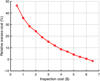 |
Fig. 6 Relative excess-cost as a function of inspection cost. |
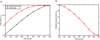 |
Fig. 7 Impact of PM cost on (a) optimal cost rate of each maintenance model and (b) relative excess-cost between the two maintenance models. |
5 Conclusions and perspectives
This study presents a novel inspection and maintenance optimization framework for rolling bearings based on the DTM, addressing the critical need for cost-effective and reliable maintenance strategies in rotating machinery. By modeling the two-stage degradation process of bearings - normal operation until defect initiation followed by a delay time to failure - the proposed DTM-based model leverages periodic inspections to identify defects and schedule preventive maintenance (PM), thereby reducing the risk of costly failures. The developed maintenance cost model optimizes the inspection interval to minimize the long-term expected cost rate, balancing inspection costs, PM costs, and corrective maintenance (CM) costs. Parameter estimation methods for Weibull-distributed defect initiation time and delay time were formulated for both continuous and discrete inspection data, using Maximum Likelihood Estimation (MLE) to ensure robust model parameterization. Validation using the FEMTO run-to-failure dataset demonstrates the practical applicability of the proposed approach, confirming its ability to accurately estimate degradation parameters and optimize maintenance schedules.
A comparative study with a conventional time-based preventive maintenance (TBM) model highlights the proposed model’s superiority, achieving a 24.4% reduction in the long-term cost rate under baseline conditions. Sensitivity analysis reveals that the DTM-based model’s cost advantage is most pronounced when inspection costs are low to moderate, providing practical guidance for implementation in industrial settings. The framework’s ability to incorporate real-time condition data through periodic inspections makes it particularly suitable for systems with limited continuous monitoring capabilities, addressing a key gap in existing maintenance strategies.
The DTM-based periodic inspection model occupies a critical, cost-effective hybrid position within the spectrum of maintenance policies. It moves significantly beyond the limitations of basic Time-Based Maintenance (TBM) by incorporating condition information through periodic checks, yet remains more logistically feasible and economical than complex, high-cost, continuous Condition-Based Maintenance (CBM) approaches that require dedicated integrated monitoring hardware. The framework's ability to incorporate real-time condition data through periodic inspections makes it particularly suitable for systems with limited continuous monitoring capabilities, addressing a key gap in existing maintenance strategies.
Future research will focus on extending the practical applicability and accuracy of the DTM-based framework. This includes addressing real-world limitations by modeling the impact of imperfect inspections and enhancing model fidelity by incorporating variable operating conditions (e.g., load and speed) into the Weibull distributions via covariates. To further optimize maintenance effectiveness, research will explore hybrid inspection strategies - combining the current periodic inspection with a non-periodic, opportunistic approach - and developing an optimized non-periodic (adaptive) inspection policy based on the DTM, which is currently an unstudied area.
Funding
This work was supported by The University of Danang - University of Science and Technology, code number of Project: T2023FSF-02-05.
Conflicts of interest
The authors declare that they have no known competing financial interests or personal relationships that could have appeared to influence the work reported in this paper.
Data availability statement
The research data associated with this article are included in the article.
Author contribution statement
Minh-Hien BUI: Methodology, Investigation, Writing - original draft.
Phuoc-Vinh DANG: Investigation, Writing - original draft.
Duc-Hanh DINH: Investigation, Writing-review & editing.
Si-Hung NGUYEN-HO: Minh-Hien BUI: Conceptualization, Methodology, supervision, Writing-review & editing.
Bao-Thuan LE-HUU: Investigation, Data Curation.
References
- X. Wang, A. Zhou, T. Zhang, Reliability and reliability sensitivity analysis of rolling bearings based on contact fatigue under finite probability information, Math. Probl. Eng. 2022, 1–13 (2022) [CrossRef] [Google Scholar]
- Y. Lei, N. Li, F. Jia, J. Lin, S. Xing, A nonlinear degradation model based method for remaining useful life prediction of rolling element bearings, in: 2015 Prognostics and System Health Management Conference (PHM), 2015, pp. 1–8 [Google Scholar]
- Y. Zhu, X. Zhou, J. Cheng, Z. Liu, X. Zou, Q. Cheng, H. Xu, Y. Wang, F. Tao, Data and model synergy-driven rolling bearings remaining useful life prediction approach based on deep neural network and Wiener process, J. Manuf. Sci. Eng. 1–58 (2024), https://doi.org/10.1115/1.4067092 [Google Scholar]
- Y. Zhang, A. Wang, Remaining useful life prediction of rolling bearings using electrostatic monitoring based on two-stage information fusion stochastic filtering, Math. Probl. Eng. 2020, 2153235 (2020) [Google Scholar]
- N. Gorjian Jolfaei, R. Rameezdeen, N. Gorjian, B. Jin, C.W.K.Chow, Prognostic modelling for industrial asset health management, Safety Reliab. 41, 45–97 (2022) [Google Scholar]
- B.J. Jenkinson, I. Jenkinson, J. Wang, Delay-time concept and its application to maintenance problems, Safety Reliab. 27, 5–19 (2007) [Google Scholar]
- Y.N. Aldeoes, P. Gokhale, S.Y. Sondkar, A review of predictive maintenance of bearing failures in rotary machines by predictive analytics using machine-learning techniques, in: A. Neustein, P.N. Mahalle, P. Joshi, G.R. Shinde (Eds.), AI, IoT, Big Data and Cloud Computing for Industry 4.0, Springer International Publishing, 2023, pp. 115–138 [Google Scholar]
- D.-H. Dinh, P. Do, V.-T. Hoang, N.-T. Vo, T.Q. Bang, A predictive maintenance policy for manufacturing systems considering degradation of health monitoring device, Reliab. Eng. Syst. Safety 248, 110177 (2024) [Google Scholar]
- M.h. Faber, New approaches to inspection planning of fatigue damaged offshore platforms, Safety Reliab. 23, 35–50 (2002) [Google Scholar]
- D.-H. Dinh, P. Do, M.-H. Bui, P.-V. Dang, A dynamic inspection model for predictive maintenance considering different degrees of inspection quality, Reliab. Eng. Syst. Safety 261, 111165 (2025) [Google Scholar]
- M. Li, P.Z.H. Sun, W. He, S. Qiu, B. Liu, Rolling bearing fault diagnosis under variable working conditions based on joint distribution adaptation and SVM, 2020, https://doi.org/10.1109/IJCNN48605.2020.9207454 [Google Scholar]
- Y. Li, X. Huang, P. Ding, C. Zhao, Wiener-based remaining useful life prediction of rolling bearings using improved Kalman filtering and adaptive modification, Measurement, 182, 109706 (2021) [Google Scholar]
- D. Kuzio, R. Zimroz, A. Wyłomańska, A modified gamma process for RUL prediction based on data with time-varying heavy-tailed distribution, Inf. Sci. 690, 121603 (2025) [Google Scholar]
- L. Wang, H. Liu, Z. Pan, D. Fan, C. Zhou, Z. Wang, Long short-term memory neural network with transfer learning and ensemble learning for remaining useful life prediction, Sensors, 22, Article 15 (2022) [Google Scholar]
- J. Guo, Z. Wang, H. Li, Y. Yang, C.-G. Huang, M. Yazdi, H.S. Kang, A hybrid prognosis scheme for rolling bearings based on a novel health indicator and nonlinear Wiener process, Reliab. Eng. Syst. Safety 245, 110014 (2024) [Google Scholar]
- Z. Pang, X. Si, C. Hu, D. Du, H. Pei, A bayesian inference for remaining useful life estimation by fusing accelerated degradation data and condition monitoring data, Reliab. Eng. Syst. Safety 208, 107341 (2021) [Google Scholar]
- W. Wang, K. Kobbacy, D. Murthy, Delay time modelling, 2008, pp. 345–370. https://doi.org/10.1007/978-1-84800-011-7_14 [Google Scholar]
- W. Wang, An overview of the recent advances in delay-time-based maintenance modelling, Reliab. Eng. Syst. Safety, 106, 165–178 (2012) [Google Scholar]
- A.C.D.J. Santos, C.A.V. Cavalcante, J. Ren, S. Wu, A novel delay time modelling method for incorporating reuse actions in three-state single-component systems, Reliab. Eng. Syst. Safety, 234, 109129 (2023) [Google Scholar]
- A. Santos, C. Cavalcante, S. Wu, Discussions on the reuse of items based on the delay time modelling, in: 11th IMA International Conference on Modelling in Industrial Maintenance and Reliability (MIMAR), 2021, June 29, Online. https://cdn.ima.org.uk/wp/wp-content/uploads/2019/09/Abstract-Book-11th-IMA-International-Conference-on-Modelling-and-Industrial-Maintenance-and-Reliability-MIMAR-1.pdf [Google Scholar]
- W. Wang, Modelling the probability assessment of system state prognosis using available condition monitoring information, IMA J. Manag. Math. 17, 225–233 (2006) [Google Scholar]
- S.M. Ross, J.J. Kelly, R.J. Sullivan, W.J. Perry, D. Mercer, R.M. Davis, T.D. Washburn, E.V. Sager, J.B. Boyce, V.L. Bristow, Stochastic processes (Wiley, New York, 1996), Vol. 2. [Google Scholar]
- Z. Liu, Y. Fu, S. Zheng, J. Wei, Study on rolling bearing life based on weibull distribution and correlation coefficient optimization and maximum likelihood estimation, J. Phys.: Conf. Ser. 2383, 012124 (2022) [Google Scholar]
- H. Abubakar, S.R.M. Sabri, Incorporating simulated annealing algorithm in the Weibull distribution for valuation of investment return of Malaysian property development sector, Int. J. Simul. Multidiscip. Des. Optim. 12, 22 (2021) [CrossRef] [EDP Sciences] [Google Scholar]
- P. Nectoux, R. Gouriveau, K. Medjaher, E. Ramasso, B. Chebel-Morello, N. Zerhouni, C. Varnier, PRONOSTIA: An experimental platform for bearings accelerated degradation tests, in: Conference on Prognostics and Health Management., sur CD ROM, 2012, pp. 1–8. https://hal.science/hal-00719503 [Google Scholar]
- J. Kim, Y. Ahn, H. Yeo, A comparative study of time-based maintenance and condition-based maintenance for optimal choice of maintenance policy, Struct. Infrastruct. Eng. 12, 1525–1536 (2016) [Google Scholar]
Cite this article as: Minh-Hien Bui, Phuoc-Vinh Dang, Duc-Hanh Dinh, Bao-Thuan Le-Huu, and Ho-Si-Hung Nguyen, Maintenance Optimization for Rolling Bearing Based on Delay Time Model, Int. J. Simul. Multidisci. Des. Optim. 17, 7 (2026), https://doi.org/10.1051/smdo/2026003
All Tables
All Figures
|
Fig. 1 Vibration data of rolling bearing (Nectoux et al., 2012). |
| In the text | |
|
Fig. 2 Delay time concept. |
| In the text | |
|
Fig. 3 Illustration of inspection and maintenance model with (a) Preventive maintenance case and (b) Corrective maintenance case. |
| In the text | |
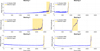 |
Fig. 4 Vibration data of the rolling bearing from FEMTO dataset [25]. |
| In the text | |
|
Fig. 5 Expected maintenance cost per unit time as a function of inspection interval. |
| In the text | |
|
Fig. 6 Relative excess-cost as a function of inspection cost. |
| In the text | |
|
Fig. 7 Impact of PM cost on (a) optimal cost rate of each maintenance model and (b) relative excess-cost between the two maintenance models. |
| In the text | |
Current usage metrics show cumulative count of Article Views (full-text article views including HTML views, PDF and ePub downloads, according to the available data) and Abstracts Views on Vision4Press platform.
Data correspond to usage on the plateform after 2015. The current usage metrics is available 48-96 hours after online publication and is updated daily on week days.
Initial download of the metrics may take a while.